
Green Water, Cloudy Water: Understanding Biological Testing to Restore Clear Water
Written by:
Last modified:
Reading time:
Does your pond need professional care?
Nothing is more frustrating than seeing your pond transform from clear water into an opaque juice, sometimes green, sometimes brown. Yet, this loss of transparency is never a coincidence. It's a sign that a fragile biological balance has been broken. A pond, unlike a river, is a closed system. Everything that enters stays there, and everything that degrades modifies its chemistry. What you observe on the surface is simply a reflection of an ecosystem trying to adapt.
To restore clear water without resorting to draining — an ecological mistake that destroys beneficial microorganisms — you must first understand what the water is trying to tell you. The goal is not to fight the water, but to restore the pond's natural homeostasis.
Green water or cloudy water? The essential diagnosis
Before any action, the nature of the problem must be identified. Green water does not have the same cause or the same solutions as brown water.
Green water is almost always linked to a phytoplankton bloom: millions of suspended microscopic algae. This phenomenon appears as soon as the temperature exceeds 14°C and light increases. It is the classic marker of water rich in dissolved nutrients, particularly nitrates and phosphates.
Brown or gray cloudy water, on the other hand, comes from suspended mineral particles: clays, dust, or silt stirred up by bottom-feeding fish. These colloidal particles are electrically charged. They repel each other, which prevents them from settling. The water then becomes opaque through a physicochemical mechanism, without any biological bloom.
Did you know?
Green water contains... life. Murky water mainly contains mineral matter and requires physico-chemical rebalancing rather than anti-algae treatment.
The most reliable diagnosis remains the coffee filter test: green water colors the paper green, while cloudy water leaves a brown or gray deposit.
The nitrogen cycle: the root of 80% of problems
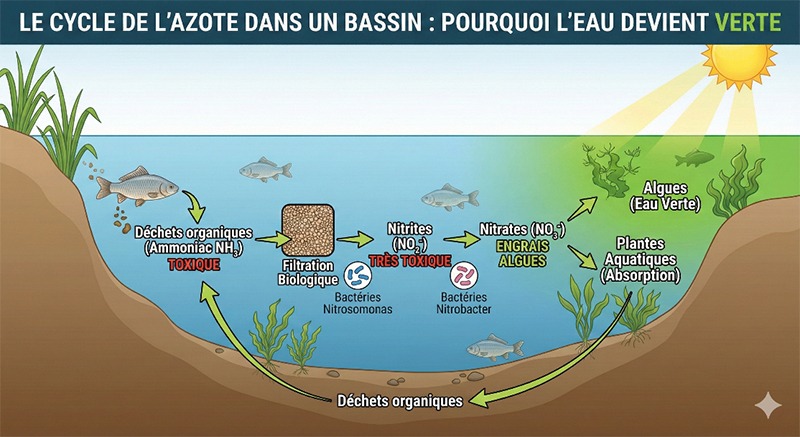
In a pond, organic waste accumulates. Dead leaves, uneaten food, fish waste: everything eventually degrades into ammonia, a toxic compound.
In a healthy system, specific bacteria transform this ammonia into nitrites and then into nitrates. This is the nitrogen cycle. The problem arises at the last stage. Nitrates, if not absorbed by aquatic plants in sufficient quantities, become pure fertilizer. Single-celled algae, much faster than plants, immediately feed on this excess.
The equation is simple and implacable: excess nitrates + light = green water.
Did you know?
A handful of uneaten food can produce enough nitrates to fuel an entire microalgae bloom for several days.
How to clarify already cloudy water?
When the water turns green or cloudy, the goal is to quickly clear the pool without killing beneficial biology or causing secondary pollution.
The first lever is physical: the UV-C lamp. Ultraviolet radiation destabilizes the DNA of microscopic algae, preventing their reproduction. The cells then become sticky, aggregate together, and form flakes large enough to be captured by mechanical filtration. It is a clean, effective, and essential method for very sunny pools.
The second lever is chemical, but gentle: calcium carbonate in the form of coccolithic chalk (Nautex). By dissolving slowly, it increases the water's carbonate hardness and stabilizes the pH, which secures the filter's biology. The calcium ions, meanwhile, play a key role: they neutralize the electrical charges of fine suspended particles, allowing them to aggregate and settle. This is the principle of natural flocculation.
The third lever, essential for a lasting result, is biological. The addition of heterotrophic bacteria allows for the recolonization of the filter and substrate. These bacteria rapidly consume available nutrients, preventing microalgae from finding the food that triggers blooms.
How to prevent green water from returning?
Once the water has cleared again, the priority is to prevent recurrences. To do this, a stable biological competition must be recreated. Submerged aquatic plants are your best allies. They absorb nitrates directly from the water column and deprive micro-algae of their energy source.
Shade is a second natural regulator: water lilies reduce surface light intensity and limit spring blooms. Finally, food rigor plays a central role. Each uneaten pellet becomes a nitrogen pollutant.
Filtration must run continuously. Turning off the pump at night kills the filter bacteria within hours. In the morning, you reintroduce septic water directly into the pond, worsening imbalances.
Summary table
| Problem | Main cause | Sustainable solution |
|---|---|---|
| Green water | Excess nitrates + light | UV-C + bioremediation + plants |
| Murky water | Charged mineral particles | Calcium (Nautex) + filtration |
| Bad nitrogen cycle | Insufficient filtration | Bacterial enhancement |
| Unstable pH | Low TAC | Calcium carbonate |
| Bloom relapses | Lack of plants | Greening of the basin |
Mini-glossary
Flocculation Process by which fine particles aggregate to form flakes and settle.
Nitrogen cycle Biological transformation of ammonia into nitrites then nitrates.
Trophic competition Rivalry between organisms for access to available nutrients.
MY Suspended matter, mineral or organic particles responsible for cloudy water.
TAC/KH Carbonate hardness, an indicator of the water's ability to stabilize its pH.
Share this article

Frequently Asked Questions: Water Diagnosis and Clarification
The most reliable and simplest test is the coffee filter test. Take a water sample and pour it through a paper filter. If the residue is green, it is a phytoplankton bloom (microscopic algae caused by excess nutrients). If the deposit is gray or brown, it consists of suspended mineral particles or silt (a physicochemical problem). This distinction is crucial because the treatment is completely different.
Green water is a sign of an imbalance in the nitrogen cycle. When the temperature exceeds 14°C, organic waste (leaves, waste) breaks down into nitrates. If the pond lacks plants to absorb these nitrates, they act as pure fertilizer. Combined with intense sunlight, they cause an immediate explosion of single-celled algae. The equation is simple: Excess nitrates + Light = Green water.
Cloudy water that is not green is caused by colloidal mineral particles (clay, dust) that repel each other electrically and do not settle. To clarify the water, these electrical charges must be neutralized using calcium ions, by adding natural calcium carbonate (Nautex). This process, known as natural flocculation, allows the particles to clump together and settle to the bottom, making the water crystal clear without harming aquatic life.
This is a major ecological mistake that must be avoided at all costs. Biological filtration relies on aerobic bacteria that need a constant flow of water to breathe. By turning off the pump at night, you deprive these bacteria of oxygen, causing them to die within a few hours. When you restart the pump in the morning, you release dead, septic water back into the pond, which makes the water murkier and promotes disease.
They work in tandem. The UV-C lamp provides a physical treatment: it damages the DNA of microscopic algae, causing them to clump together and get trapped in the filter. Aquatic plants, on the other hand, offer a biological solution: by consuming nitrates, they compete with the algae for nutrients and deprive them of food, thereby preventing the return of green water.
Related topics
Need more information or have a question?
Our dedicated team will get back to you as soon as possible.