
Thermodynamics and Eutrophication: Why Your Body of Water Is Aging 100 Times Faster Today
Written by:
Last modified:
Reading time:
Does your pond need professional care?
A body of water is not a frozen natural pool. It is a thermodynamic bioreactor complex, constantly crossed by exchanges of heat, gas, and organic matter.
On a geological scale, every lake follows the same trajectory: it is born, gradually fills up, and ends as a wet meadow. This cycle used to take millennia. Today, under the combined effects of human activities and climate change, it can occur in just a few decades.
We speak of cultural eutrophication: an acceleration of aging caused by our practices. For a manager, a community, or a private owner, understanding these invisible mechanisms becomes a condition for the sustainable protection of their aquatic heritage.
The watershed's "immune debt"
The health of a pond is determined well before the waterline. It depends on everything that happens in the territory that feeds it.
A body of water is generally born in an oligotrophic state: clear water, low nutrient content, dissolved oxygen close to saturation. This initial state is that of a young environment, still lightly loaded with organic matter.
Extreme climatic events have profoundly altered this situation. During periods of drought, soils mineralize, become hard, and sometimes hydrophobic. When a violent rain occurs, the water no longer penetrates: it runs off. It tears away with it suspended solids (MES), nitrates, and phosphorus, which it transports directly to the body of water.
Where slow infiltration once allowed the soil to filter and retain some pollutants, we now observe real "hydraulic shocks." The pond begins its season with an oxygen deficit and a stock of nutrients and particles that will take months to manage.
Intense rain on dry soil can bring as many fine particles and nutrients to a small pond as moderate rain spread over several weeks. It's not just the quantity of water that matters, but the speed and intensity of runoff.
Physics: Henry's Law and the thermal trap
Heat is the discreet but major enemy of aquatic balance. Henry's law explains that the hotter the water, the less gas it can dissolve, particularly oxygen.
As a rough estimate:
- at 5 °C, fresh water can contain about 12.8 mg/L of dissolved oxygen;
- at 25 °C, this ceiling drops to about 8.2 mg/L.
Without any additional pollution, a body of water therefore loses about 35% of its respiratory capacity simply because it heats up.
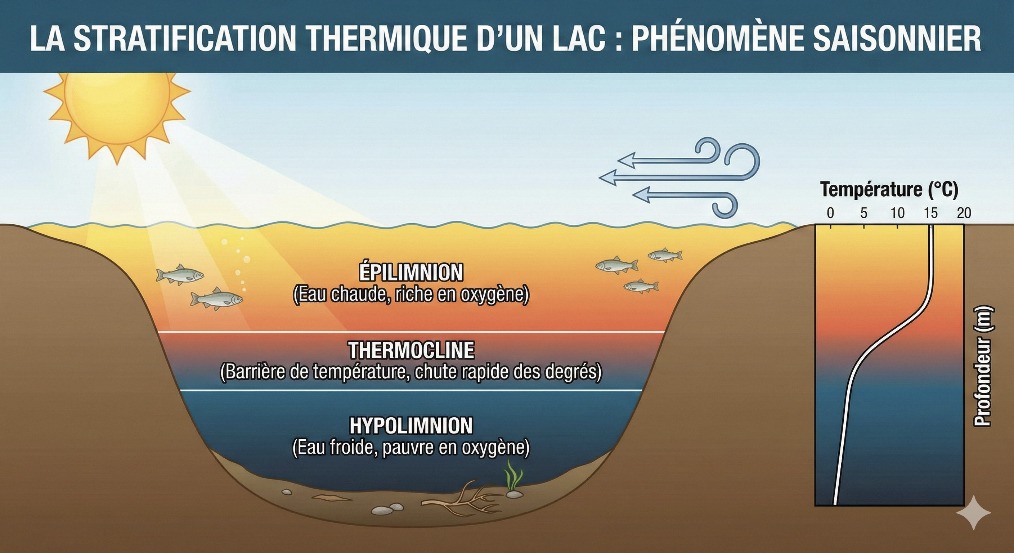
In bodies of water more than 3 to 4 meters deep, heat causes thermal stratification. A layer of warm, light water on the surface (the epilimnion) floats above a cold, dense layer at the bottom (the hypolimnion). Between the two, a distinct transition zone forms: the thermocline. This boundary strongly limits vertical mixing.
The oxygen from the air can no longer supply the bottom, even as the sediments continue to consume the available oxygen. The deficit sets in gradually until total depletion.
Background Chemistry: Redox Potential and Phosphorus Release
When oxygen disappears in contact with sediments, the chemical conditions change. It is the redox potential that reflects this state: it decreases as the environment becomes reducing.
In well-oxygenated environments, phosphorus present in the sediment is strongly bound by oxidized iron (Fe³⁺). The iron then acts like a "magnet" that retains phosphorus in the sediments. As long as this configuration persists, the sediment acts as a phosphorus sink.
When oxygen becomes scarce, the redox potential collapses. Iron transforms into ferrous iron (Fe²⁺), which no longer has the same binding capacity. Phosphorus is then released into the water.
This process, often called internal loading, explains why a body of water can remain nutrient-rich and produce green tides even after its external inputs have been significantly reduced. The sediment, once a reservoir, transforms into a permanent diffuse source.
Good to know:
The black or dark gray color of a vase, the "sulfur" (rotten egg) smell, or the presence of continuously rising bubbles are often indicators of an oxygen-depleted bottom, with a low redox potential.
Biology: why cyanobacteria gain the advantage
In warm, phosphorus-rich, recirculating water, biological competition is completely skewed. Conventional green algae, which normally form the base of the food chain, are disadvantaged. It is the cyanobacteria that take over.
These microorganisms possess several major advantages in the current context:
- they develop very well above 25°C, where many other species are under thermal stress;
- they have gas vesicles that allow them to regulate their buoyancy vertically: they rise to the surface to capture light and form the visible "blooms," while shading other primary producers;
- some species are capable of drawing nitrogen directly from dissolved nitrogen in the water, making them less dependent on present mineral nitrogen forms.
The risk is not only ecological but also sanitary. Some cyanobacteria produce cyanotoxins, substances potentially dangerous for fauna, domestic animals, and, in some cases, human users (irritations, digestive disorders, liver or neurological damage depending on the toxins).
Carbon footprint: when a pond becomes a greenhouse gas emitter
A body of water in good condition acts as a carbon sink: CO₂ captured by photosynthesis is partly stored as organic matter in the sediments. But when oxygen is lacking in the depths, the way this matter degrades changes.
In an oxygen-free environment, specific bacteria, called methanogens, take over. They degrade organic matter through fermentative pathways that result in the production of methane (CH₄). This gas then escapes as bubbles to the surface.
Methane has a much higher global warming potential than CO₂: around 28 times over 100 years, and up to 80 times over shorter horizons. A heavily degraded and poorly ventilated body of water can therefore become a net greenhouse gas emitter.
Did you know?
Globally, degraded wetlands and water bodies represent a significant share of methane emissions. Restoring a pond is not just about improving a landscape: it is also a concrete action for the climate.
Towards genuine resilience engineering
Old approaches based on "laissez-faire" or, conversely, on brutal chemical interventions (e.g., copper sulfate) are no longer suitable. They ignore the real complexity of the mechanisms involved and can worsen the situation in the medium term.
Modern management of a body of water relies on resilience engineering. It aims not to return to a "perfect" state, but to restore the environment's capacity to buffer shocks: heatwaves, sudden nutrient inputs, and water level variations.
This involves three complementary approaches:
- Reduce pressure at the source
Improve practices in the territory: grass strips, bank vegetation, limitation of runoff loaded with suspended solids and nutrients. - Act on internal chemistry
Utilize suitable mineral solutions (e.g., technical calcium-based materials like Nautex, or other specific supports) to capture phosphorus and promote clarification, while respecting the bottom's balance. - Reactivate background biology
Stimulate the natural degradation of silt (bio-dredging, targeted bacterial inputs) and maintain sufficient redox potential through bottom aeration devices, in order to prevent iron from releasing phosphorus again.
Diagnosing, understanding the invisible chemistry, and acting on the causes rather than the symptoms: this is the condition for guaranteeing the sustainability of your body of water in an increasingly demanding climate context.
| Step | Main mechanism | Impact on the body of water |
|---|---|---|
| Water heating | Decrease in oxygen solubility (Henry's Law) | Decrease in the respiratory capacity of the environment |
| Thermal stratification | Epilimnion / hypolimnion separation, thermocline formation | Background isolation, oxygen deficit at depth |
| Redox potential drop | Transformation of oxidized iron into ferrous iron | The release of phosphorus stored in sediments |
| Nutrient enrichment | Available phosphorus in the water column | Promotes cyanobacterial blooms |
| Degradation without oxygen | Fermentation by methanogenic bacteria | Increased methane production, GHG emissions |
Share this article

Frequently Asked Questions: Eutrophication & Thermodynamics
Thermal stratification is a natural physical phenomenon that occurs in deep bodies of water (generally deeper than 3 meters) during the summer. The water divides into layers of different temperatures that no longer mix: a warm layer at the surface (epilimnion) and a cold layer at the bottom (hypolimnion), separated by a boundary called the thermocline. This stratification prevents surface oxygen from reaching the bottom, causing oxygen depletion in deep areas.
This phenomenon is linked to the dissolved oxygen cycle. During the day, algae produce oxygen through photosynthesis. But at night, photosynthesis stops, and all organisms (fish, plants, bacteria) continue to breathe, consuming the available oxygen. In warm water (which holds oxygen less effectively according to Henry’s law), this nighttime consumption can completely deplete oxygen reserves. Oxygen levels reach their lowest point just before sunrise, causing fish to suffocate.
Global warming acts as a catalyst. Warmer water promotes the rapid growth of cyanobacteria at the expense of healthy algae. In addition, heat reduces the water’s ability to store oxygen and increases thermal stratification, which accelerates the decomposition of sediment and the internal release of phosphorus. Droughts followed by severe storms also increase the sudden influx of nutrients via runoff.
Redox potential is an electrical measure that indicates the chemical health of sediments. A high (positive) redox potential means that the environment is rich in oxygen (aerobic conditions): iron binds phosphorus, and the sediment decomposes healthily. A low (negative) redox potential indicates a suffocated environment (anaerobic conditions): phosphorus is released into the water, feeding algae, and toxic gases (methane, H₂S) are produced.
This is the phenomenon of "internal release" (or internal loading). Even if you cut off external inputs, the sediment accumulated at the bottom of your pond over the years acts as a phosphorus reserve. When oxygen is lacking at the bottom (often in summer), this phosphorus stock is chemically released into the water, feeding the algae on the surface. This is why the sediment must be treated (bioremediation) to permanently stop the green water.
Related topics
Need more information or have a question?
Our dedicated team will get back to you as soon as possible.