
Nautex vs. Slaked Lime: The Showdown
Written by:
Last modified:
Reading time:

Does your pond need professional care?
As professionals, we are often asked about the difference between slaked lime and Nautex. Some claim they are the same thing and that the results are identical, so let's try to clarify.
Scientific Comparison between Calcium Hydroxide andCalcium Carbonatein Pond Management
The effective management of ponds and water bodies often involves the use of chemicals to regulate pH, improve water quality, and maintain a healthy environment for aquatic life. Two such commonly used products are calcium hydroxide (Ca(OH)2) and calcium carbonate (CaCO3) or NAUTEX. While they share chemical similarities as calcium compounds, they present significant differences in terms of applications and effectiveness.
Chemical Composition:
Calcium hydroxide is composed of one calcium atom (Ca), two oxygen atoms (O), and two hydrogen atoms (H). Its chemical formula is Ca(OH)2.
Calcium carbonate, meanwhile, is composed of one calcium atom (Ca), one carbon atom (C), and three oxygen atoms (O). Its chemical formula is CaCO3.
Key Differences:
- pH Reaction: One of the main differences lies in their reaction to water pH. Calcium hydroxide is a strong alkali and rapidly increases water pH when added. Calcium carbonate, on the other hand, acts as a buffer, regulating pH more stably and gradually.
- Solubility: Calcium hydroxide is more soluble in water than calcium carbonate. This means it can react more quickly, but its reaction may also be more difficult to control.
- Application: Calcium hydroxide is often used to rapidly increase water pH in situations where a quick adjustment is needed. Calcium carbonate is preferred in cases where long-term pH stabilization is required, making it a wise choice for long-term pond management.
Advantages of Calcium Carbonate in Pond Management:
Calcium carbonate calcium carbonate offers several advantages in pond management compared to calcium hydroxide:
- Long-Term Stability: As a pH buffer, calcium carbonate maintains water pH more stably over a prolonged period, which is essential for the health of aquatic organisms.
- Gradual Control: It allows for a more gradual adjustment of pH, avoiding abrupt fluctuations that could be harmful to aquatic life.
- Cost Reduction: Due to its lower solubility, calcium carbonate may require less frequent applications, reducing long-term management costs.
In conclusion, although calcium hydroxide and Chalk share similarities as calcium compounds, their reactions to pH, solubility, and applications differ considerably. In pond management, calcium carbonate offers a more stable and economical solution for long-term pH maintenance, making it a preferred choice for managers concerned about the health of their water bodies.
The NAUTEX: the "paracetamol of waterways"
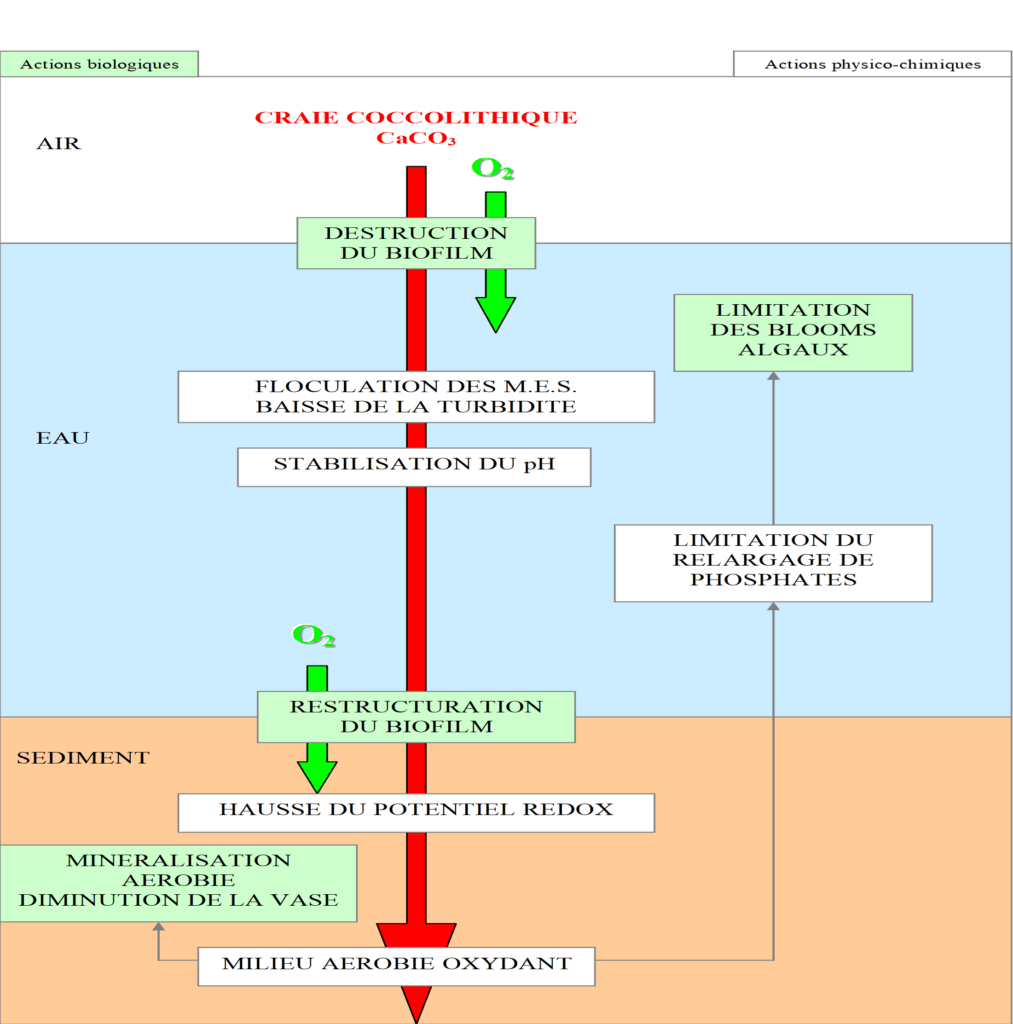
NAUTEX, also called coccolith chalk or Champagne chalk, is a mineral composed mainly of natural carbonate of calcium of sedimentary origin, 60 million years old. Its chemical formula is CaCO3.
It is particularly prized by fish farm operators, fishing ponds, and all institutions concerned with maintaining an optimal balance in aquatic environments. It is perfectly suited to all biotopes as it acts as a biostimulant for aerobic bacterial microfauna.
The NAUTEX is specifically designed to address problems related to the excessive presence of organic matter in bodies of water, lakes, and ponds. Indeed, its presence helps to oxygenate the water and limit the accumulation of organic silt, while offering numerous additional benefits.
Thanks to its pH-regulating action and the increase in oxygen content dissolved, NAUTEX helps to rapidly restore the ecological and biological balance of aquatic ecosystems. It also promotes photosynthesis in aquatic plants and thus improves water oxygenation.
On the one hand, it acts physically by aggregating the suspended particles in the water, thus facilitating their removal at the bottom of the reservoir. On the other hand, it acts biologically by promoting the degradation of organic matter present in the sediment. This process helps to improve water quality by reducing organic pollution and decreasing the amount of nitrogen and phosphorus available for algae. The use of NAUTEX is therefore highly relevant in the management of water bodies and aquatic environments. It helps to reduce the presence of undesirable organic matter, prevent the proliferation of harmful algae, phytoplankton, or filamentous algae, and preserve water quality.
Furthermore, itsusageis part of an environmentally friendly approach, bylimitingtherejections chemicals and pollutionand by promoting the natural degradation oforganic matter. Whether for the development of bodies of water intended for fishing, thepreservationofecosystems aquatic: or the supply ofdrinking water, NAUTEX offers an effective and sustainable solution. It helps maintain thebiodiversityand the health ofecosystems aquatic, and allows thefishermenand to leisure enthusiastsaquaticto take advantage ofnatural environmentspreserved, conducive to fishing, to theswimming: or to relax inborderofbanks.
The NAUTEX represents a major asset in theenvironmental management aquatic. Its beneficial action on water quality, the reduction oforganic pollutionand its positive impact on theecosystemsmaking it a prime ally for all those seeking to preserve and rehabilitate theaquatic environments.
It acts by accelerating the aerobic mineralization of organic matter, particularly total nitrogen and total phosphorus present in the water column. These organic residues originate from fertilizers found in manure or industrial chemical products that contribute to the eutrophication of bodies of water or ponds. These disturbances and nutrient inputs cause an increase in biomass, notably of filamentous algae, aquatic plants, and microorganisms, which can prove toxic.
By treating bodies of water, lakes, and ponds with NAUTEX, the ecological state of the ponds is improved, and it also enhances the protection of aquatic environments. Nautex should be spread on the surface of water bodies, and to maximize its effectiveness, it should be mixed with water and spread using a jet system or a motor pump.
Share this article

Related topics

Need more information or have a question?
Our dedicated team will get back to you as soon as possible.