
Eau verte, eau trouble : comprendre le diagnostic biologique pour retrouver une eau claire
Écrit par :
Modifié le :
Temps de lecture :

Votre plan d’eau à besoin d’une expertise ?
Rien n’est plus frustrant que de voir son bassin se transformer d’une eau limpide en un jus opaque, tantôt vert, tantôt brun. Pourtant, cette perte de transparence n’est jamais un hasard. C’est le signe qu’un équilibre biologique fragile s’est rompu. Un bassin, contrairement à une rivière, est un système clos. Tout ce qui y entre y reste, et tout ce qui s’y dégrade modifie sa chimie. Ce que vous observez à la surface est simplement le reflet d’un écosystème qui tente de s’adapter.
Pour retrouver une eau claire sans recourir à la vidange — une erreur écologique qui détruit les micro-organismes utiles — il faut d’abord comprendre ce que l’eau tente de vous dire. L’objectif n’est pas de lutter contre l’eau, mais de restaurer l’homéostasie naturelle du bassin.
Eau verte ou eau trouble ? Le diagnostic indispensable
Avant toute action, il faut identifier la nature du trouble. Une eau verte n’a pas la même cause ni les mêmes solutions qu’une eau brune.
L’eau verte est presque toujours liée à un bloom de phytoplancton : des millions d’algues microscopiques en suspension. Ce phénomène apparaît dès que la température dépasse les 14°C et que la lumière augmente. C’est le marqueur classique d’une eau riche en nutriments dissous, notamment en nitrates et en phosphates.
L’eau trouble brune ou grise, en revanche, provient de particules minérales en suspension : argiles, poussières ou vase remise en mouvement par les poissons fouilleurs. Ces particules colloïdales sont électriquement chargées. Elles se repoussent mutuellement, ce qui empêche leur décantation. L’eau devient alors opaque par mécanisme physico-chimique, sans aucun bloom biologique.
Le saviez-vous ?
Une eau verte contient… de la vie. Une eau trouble contient surtout de la matière minérale et nécessite un rééquilibrage physico-chimique plutôt qu’un traitement anti-algues.
Le diagnostic le plus fiable reste le test du filtre à café : une eau verte colore le papier en vert, tandis qu’une eau trouble laisse un dépôt brun ou gris.
Le cycle de l’azote : la racine de 80 % des problèmes
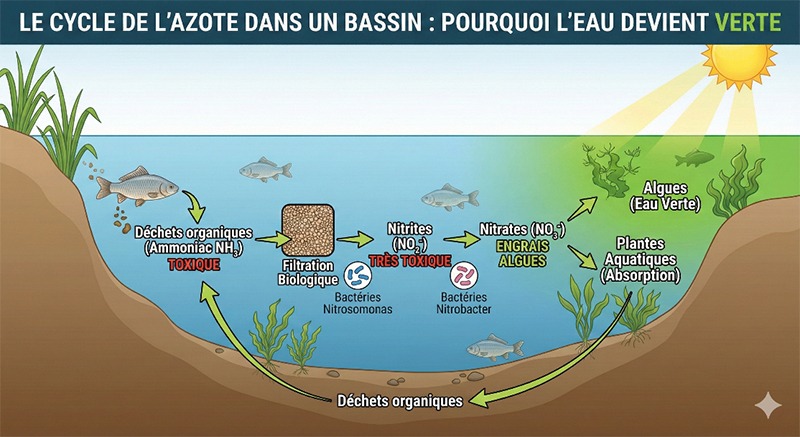
Dans un bassin, les déchets organiques s’accumulent. Feuilles mortes, nourritures non consommées, déjections des poissons : tout finit par se dégrader en ammoniac, un composé toxique.
Dans un système sain, des bactéries spécifiques transforment cet ammoniac en nitrites puis en nitrates. C’est le cycle de l’azote. Le problème survient à la dernière étape. Les nitrates, s’ils ne sont pas absorbés par des plantes aquatiques en quantité suffisante, deviennent un engrais pur. Les algues unicellulaires, beaucoup plus rapides que les plantes, se nourrissent immédiatement de cet excès.
L’équation est simple et implacable : excès de nitrates + lumière = eau verte.
Le saviez-vous ?
Une poignée de nourriture non consommée peut produire assez de nitrates pour alimenter un bloom entier de micro-algues pendant plusieurs jours.
Comment clarifier une eau déjà opaque ?
Lorsque l’eau est devenue verte ou trouble, l’objectif est de soulager rapidement le bassin, sans tuer la biologie utile ni provoquer une pollution secondaire.
Le premier levier est physique : la lampe UV-C. Le rayonnement ultraviolet déstabilise l’ADN des algues microscopiques, empêchant leur reproduction. Les cellules deviennent alors collantes, s’agrègent entre elles et forment des flocons suffisamment gros pour être capturés par la filtration mécanique. C’est une méthode propre, efficace et indispensable sur les bassins très ensoleillés.
Le deuxième levier est chimique, mais doux : le carbonate de calcium sous forme de craie coccolithique (Nautex). En se dissolvant lentement, il augmente la dureté carbonatée de l’eau et stabilise le pH, ce qui sécurise la biologie du filtre. Les ions calcium, quant à eux, jouent un rôle clé : ils neutralisent les charges électriques des fines particules en suspension, permettant leur agglomération et leur décantation. C’est le principe de la floculation naturelle.
Le troisième levier, essentiel pour un résultat durable, est biologique. L’ajout de bactéries hétérotrophes permet de recoloniser le filtre et le substrat. Ces bactéries consomment rapidement les nutriments disponibles, empêchant les micro-algues de trouver la nourriture qui déclenche les blooms.
Comment éviter le retour de l’eau verte ?
Une fois l’eau redevenue claire, la priorité est d’éviter les récidives. Pour cela, il faut recréer une concurrence biologique stable. Les plantes aquatiques immergées sont vos meilleures alliées. Elles absorbent les nitrates directement dans la colonne d’eau et privent les micro-algues de leur source d’énergie.
L’ombre est un second régulateur naturel : les nénuphars réduisent l’intensité lumineuse en surface et limitent les proliférations printanières. Enfin, la rigueur alimentaire joue un rôle central. Chaque granulé non consommé devient un polluant azoté.
La filtration doit fonctionner en continu. Couper la pompe la nuit tue les bactéries du filtre en quelques heures. Le matin, vous réinjectez une eau septicée directement dans le bassin, aggravant les déséquilibres.
Tableau récapitulatif
| Problème | Cause principale | Solution durable |
|---|---|---|
| Eau verte | Excès de nitrates + lumière | UV-C + bioremédiation + plantes |
| Eau trouble | Particules minérales chargées | Calcium (Nautex) + filtration |
| Mauvais cycle de l’azote | Filtration insuffisante | Renforcement bactérien |
| pH instable | TAC faible | Carbonate de calcium |
| Récidives de blooms | Manque de plantes | Végétalisation du bassin |
Mini-lexique
Floculation : Processus par lequel des particules fines s’assemblent pour former des flocons et décantent.
Cycle de l’azote : Transformation biologique de l’ammoniac en nitrites puis nitrates.
Compétition trophique : Rivalité entre organismes pour l’accès aux nutriments disponibles.
MES : Matières en suspension, particules minérales ou organiques responsables de l’eau trouble.
TAC/KH : Dureté carbonatée, indicateur de la capacité de l’eau à stabiliser son pH.
Partager cet article

Foire aux questions : diagnostic et clarification de l’eau
Le diagnostic le plus fiable et le plus simple est le test du filtre à café. Prélevez un échantillon d’eau et versez-le à travers un filtre papier. Si le résidu est vert, il s’agit d’un bloom de phytoplancton (algues microscopiques liées à un excès de nutriments). Si le dépôt est gris ou brun, il s’agit de particules minérales ou de vase en suspension (problème physico-chimique). Cette distinction est cruciale car le traitement diffère totalement.
L’eau verte est le symptôme d’un déséquilibre du cycle de l’azote. Lorsque la température dépasse 14°C, les déchets organiques (feuilles, déjections) se dégradent en nitrates. Si le bassin manque de plantes pour absorber ces nitrates, ils agissent comme un engrais pur. Combinés à la lumière solaire intense, ils provoquent une explosion immédiate d’algues unicellulaires. L’équation est simple : Excès de nitrates + Lumière = Eau verte.
Une eau trouble non verte est causée par des particules minérales colloïdales (argiles, poussières) qui se repoussent électriquement et ne décantent pas. Pour clarifier l’eau, il faut neutraliser ces charges électriques grâce à des ions calcium, par l’ajout de carbonate de calcium naturel (Nautex). Ce procédé, appelé floculation naturelle, permet aux particules de s’agglomérer et de retomber au fond, rendant l’eau cristalline sans nuire à la biologie.
C’est une erreur écologique majeure à éviter absolument. La filtration biologique repose sur des bactéries aérobies qui ont besoin d’un flux d’eau constant pour respirer. En coupant la pompe la nuit, vous privez ces bactéries d’oxygène, provoquant leur mort en quelques heures. Au redémarrage le matin, vous rejetez une eau morte et septique dans le bassin, ce qui aggrave l’eau trouble et favorise les maladies.
Ils agissent de manière complémentaire. La lampe UV-C est une solution curative physique : elle endommage l’ADN des algues microscopiques pour les agglomérer et les piéger dans le filtre. Les plantes aquatiques, quant à elles, assurent la prévention biologique : en consommant les nitrates, elles entrent en compétition alimentaire avec les algues et les privent de nourriture, empêchant ainsi le retour de l’eau verte.
Sur le même thème

Besoin d’informations, une question ?
Notre équipe dédiée vous répondra dans les plus brefs délais.