
Thermodynamique et eutrophisation : pourquoi votre plan d’eau vieillit 100 fois plus vite aujourd’hui
Écrit par :
Modifié le :
Temps de lecture :
Plan de l’article
- La “dette immunitaire” du bassin versant
- Physique : la loi de Henry et le piège thermique
- Chimie du fond : potentiel redox et libération du phosphore
- Biologie : pourquoi les cyanobactéries prennent l’avantage
- Impact carbone : quand l’étang devient émetteur de gaz à effet de serre
- Besoin d’informations, une question ?

Votre plan d’eau à besoin d’une expertise ?
Un plan d’eau n’est pas une piscine naturelle figée. C’est un bioréacteur thermodynamique complexe, traversé en permanence par des échanges de chaleur, de gaz et de matière organique.
À l’échelle géologique, tout lac suit la même trajectoire : il naît, se comble peu à peu, puis finit en prairie humide. Ce cycle prenait autrefois des millénaires. Aujourd’hui, sous l’effet cumulé des activités humaines et du changement climatique, il peut se dérouler en quelques décennies seulement.
On parle d’eutrophisation culturelle : une accélération du vieillissement causée par nos pratiques. Pour un gestionnaire, une collectivité ou un propriétaire privé, comprendre ces mécanismes invisibles devient une condition pour protéger durablement son patrimoine aquatique.
La “dette immunitaire” du bassin versant
La santé d’un étang se joue bien avant la ligne d’eau. Elle dépend de tout ce qui se passe sur le territoire qui l’alimente.
Un plan d’eau naît généralement dans un état oligotrophe : eau claire, faible teneur en nutriments, oxygène dissous proche de la saturation. Cet état initial est celui d’un milieu jeune, encore peu chargé en matière organique.
Les épisodes climatiques extrêmes ont profondément modifié cette situation. En période de sécheresse, les sols se minéralisent, deviennent durs et parfois hydrophobes. Lorsqu’une pluie violente survient, l’eau ne pénètre plus : elle ruisselle. Elle arrache avec elle des matières en suspension (MES), des nitrates et du phosphore, qu’elle transporte directement vers le plan d’eau.
Là où jadis l’infiltration lente permettait au sol de filtrer et de retenir une partie des polluants, on observe désormais de véritables “chocs hydrauliques”. L’étang commence sa saison avec une dette d’oxygène et un stock de nutriments et de particules qu’il mettra des mois à gérer.
Une pluie intense sur un sol sec peut apporter à un petit étang autant de particules fines et de nutriments qu’une pluie modérée étalée sur plusieurs semaines. Ce n’est pas seulement la quantité d’eau qui compte, mais la vitesse et l’intensité du ruissellement.
Physique : la loi de Henry et le piège thermique
La chaleur est l’ennemi discret mais majeur de l’équilibre aquatique. La loi de Henry explique que plus l’eau est chaude, moins elle peut dissoudre de gaz, notamment l’oxygène.
À titre d’ordre de grandeur :
- à 5 °C, une eau douce peut contenir environ 12,8 mg/L d’oxygène dissous ;
- à 25 °C, ce plafond tombe à environ 8,2 mg/L.
Sans aucune pollution supplémentaire, un plan d’eau perd donc environ 35 % de sa capacité respiratoire simplement parce qu’il se réchauffe.
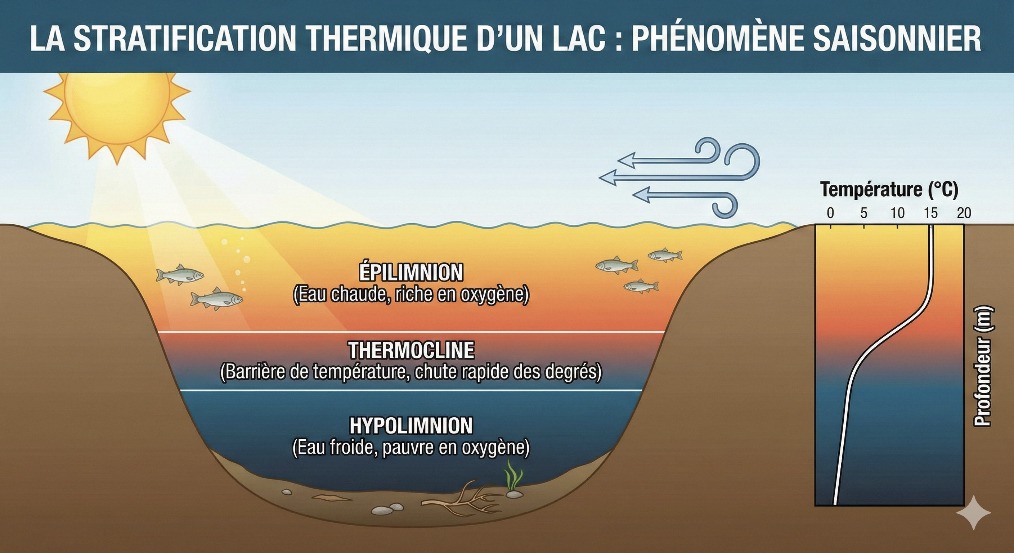
Dans les plans d’eau de plus de 3 à 4 mètres de profondeur, la chaleur provoque une stratification thermique. Une couche d’eau chaude et légère en surface (l’épilimnion) flotte au-dessus d’une couche froide et dense en profondeur (l’hypolimnion). Entre les deux se forme une zone de transition marquée : la thermocline. Cette frontière limite fortement le mélange vertical.
L’oxygène de l’air ne parvient plus à alimenter le fond, alors même que les sédiments continuent de consommer l’oxygène disponible. Le déficit s’installe progressivement jusqu’à l’épuisement total.
Chimie du fond : potentiel redox et libération du phosphore
Lorsque l’oxygène disparaît au contact des sédiments, les conditions chimiques changent. C’est le potentiel redox qui traduit cet état : il diminue à mesure que le milieu devient réducteur.
En milieu bien oxygéné, le phosphore présent dans le fond est solidement fixé par le fer oxydé (Fe³⁺). Le fer agit alors comme un “aimant” qui retient le phosphore dans les sédiments. Tant que cette configuration persiste, le fond joue le rôle de puits à phosphore.
Lorsque l’oxygène se raréfie, le potentiel redox s’effondre. Le fer se transforme en fer ferreux (Fe²⁺), qui ne possède plus la même capacité de fixation. Le phosphore est alors relâché dans l’eau.
Ce processus, souvent appelé relargage interne, explique pourquoi un plan d’eau peut rester chargé en nutriments et produire des eaux vertes même après avoir réduit fortement ses apports externes. Le sédiment, autrefois réservoir, se transforme en source diffuse permanente.
Bon à savoir :
La couleur noire ou gris foncé d’une vase, l’odeur de “soufre” (œuf pourri) ou la présence de bulles qui remontent en continu sont souvent des indicateurs d’un fond appauvri en oxygène, avec un potentiel redox bas.
Biologie : pourquoi les cyanobactéries prennent l’avantage
Dans une eau chaude, riche en phosphore remis en circulation, la compétition biologique est totalement biaisée. Les algues vertes classiques, qui forment normalement la base de la chaîne alimentaire, sont défavorisées. Ce sont les cyanobactéries qui occupent la place.
Ces micro-organismes possèdent plusieurs atouts majeurs dans le contexte actuel :
- elles se développent très bien au-delà de 25 °C, là où beaucoup d’autres espèces sont en stress thermique ;
- elles disposent de vésicules gazeuses leur permettant de régler leur flottabilité verticalement : elles montent en surface pour capter la lumière et forment les “blooms” visibles, tout en faisant de l’ombre aux autres producteurs primaires ;
- certaines espèces sont capables de puiser l’azote directement dans l’azote dissous de l’eau, ce qui les rend moins dépendantes des formes d’azote minéral présentes.
Le risque n’est pas seulement écologique mais aussi sanitaire. Certaines cyanobactéries produisent des cyanotoxines, substances potentiellement dangereuses pour la faune, les animaux domestiques et, dans certains cas, les usagers humains (irritations, troubles digestifs, atteintes hépatiques ou neurologiques selon les toxines).
Impact carbone : quand l’étang devient émetteur de gaz à effet de serre
Un plan d’eau en bon état joue un rôle de puits de carbone : le CO₂ capté par la photosynthèse est en partie stocké sous forme de matière organique dans les sédiments. Mais lorsque l’oxygène manque en profondeur, le mode de dégradation de cette matière change.
En milieu dépourvu d’oxygène, des bactéries spécifiques, dites méthanogènes, prennent le relais. Elles dégradent la matière organique par des voies fermentaires qui aboutissent à la production de méthane (CH₄). Ce gaz s’échappe ensuite sous forme de bulles à la surface.
Le méthane possède un pouvoir de réchauffement global bien plus élevé que le CO₂ : de l’ordre de 28 fois sur 100 ans, et jusqu’à 80 fois sur des horizons plus courts. Un plan d’eau fortement dégradé et mal ventilé peut donc devenir un émetteur net de gaz à effet de serre.
Le saviez-vous ?
À l’échelle mondiale, les zones humides et plans d’eau dégradés représentent une part non négligeable des émissions de méthane. Restaurer un étang, ce n’est pas seulement améliorer un paysage : c’est aussi un geste concret pour le climat.
Vers une véritable ingénierie de la résilience
Les approches anciennes fondées sur le “laisser-faire” ou, à l’inverse, sur des interventions chimiques brutales (par exemple le sulfate de cuivre) ne sont plus adaptées. Elles ignorent la complexité réelle des mécanismes en jeu et peuvent aggraver la situation à moyen terme.
La gestion moderne d’un plan d’eau repose sur une ingénierie de la résilience. Elle vise non pas à revenir à un état “parfait”, mais à redonner au milieu la capacité de tamponner les chocs : épisodes de chaleur, apports soudains en nutriments, variations de niveau.
Cela passe par trois axes complémentaires :
- Réduire les pressions à la source
Améliorer les pratiques sur le territoire : bandes enherbées, végétalisation des berges, limitation du ruissellement chargé en MES et nutriments. - Agir sur la chimie interne
Utiliser des solutions minérales adaptées (par exemple des matériaux à base de calcium technique comme le Nautex, ou d’autres supports spécifiques) pour capter le phosphore et favoriser la clarification, tout en respectant l’équilibre du fond. - Réactiver la biologie du fond
Stimuler la dégradation naturelle de la vase (bio-dragage, apports bactériens ciblés) et maintenir un potentiel redox suffisant grâce à des dispositifs d’aération de fond, afin d’éviter que le fer ne relâche à nouveau le phosphore.
Diagnostiquer, comprendre la chimie invisible, et agir sur les causes plutôt que sur les symptômes : c’est la condition pour garantir la pérennité de votre plan d’eau dans un contexte climatique de plus en plus exigeant.
| Étape | Mécanisme principal | Conséquence sur le plan d’eau |
|---|---|---|
| Réchauffement de l’eau | Diminution de la solubilité de l’oxygène (loi de Henry) | Baisse de la capacité respiratoire du milieu |
| Stratification thermique | Séparation épilimnion / hypolimnion, formation de la thermocline | Isolement du fond, déficit d’oxygène en profondeur |
| Baisse du potentiel redox | Transformation du fer oxydé en fer ferreux | Libération du phosphore stocké dans les sédiments |
| Enrichissement en nutriments | Phosphore disponible dans la colonne d’eau | Favorise les blooms de cyanobactéries |
| Dégradation sans oxygène | Fermentation par les bactéries méthanogènes | Production accrue de méthane, émissions de GES |
Partager cet article

Foire aux questions : eutrophisation & thermodynamique
La stratification thermique est un phénomène physique naturel qui se produit dans les plans d’eau profonds (généralement plus de 3 mètres) en été. L’eau se divise en couches de températures différentes qui ne se mélangent plus : une couche chaude en surface (épilimnion) et une couche froide au fond (hypolimnion), séparées par une frontière appelée thermocline. Ce cloisonnement empêche l’oxygène de surface d’atteindre le fond, provoquant l’asphyxie des zones profondes.
Ce phénomène est lié au cycle de l’oxygène dissous. En journée, les algues produisent de l’oxygène par photosynthèse. Mais la nuit, la photosynthèse s’arrête et tous les organismes (poissons, plantes, bactéries) continuent de respirer, consommant l’oxygène disponible. Dans une eau chaude (qui retient moins bien l’oxygène selon la loi de Henry), cette consommation nocturne peut épuiser totalement les réserves. Le taux d’oxygène atteint son minimum juste avant le lever du soleil, provoquant l’asphyxie des poissons.
Le réchauffement climatique agit comme un catalyseur. Une eau plus chaude favorise la croissance rapide des cyanobactéries au détriment des algues saines. De plus, la chaleur diminue la capacité de l’eau à stocker l’oxygène et renforce la stratification thermique, ce qui accélère la fermentation des vases et le relargage interne du phosphore. Les épisodes de sécheresse suivis d’orages violents augmentent également l’apport brutal de nutriments par ruissellement.
Le potentiel redox (ou potentiel d’oxydo-réduction) est une mesure électrique qui indique l’état de santé chimique des sédiments. Un potentiel redox élevé (positif) signifie que le milieu est riche en oxygène (aérobiose) : le fer retient le phosphore et la vase se dégrade sainement. Un potentiel redox bas (négatif) indique un milieu asphyxié (anaérobiose) : le phosphore est relâché dans l’eau, nourrissant les algues, et des gaz toxiques (méthane, H₂S) sont produits.
C’est le phénomène de « relargage interne » (ou charge interne). Même si vous coupez les apports extérieurs, les sédiments accumulés au fond de votre étang au fil des années agissent comme une réserve de phosphore. Lorsque l’oxygène manque au fond (souvent en été), ce stock de phosphore est libéré chimiquement dans l’eau, alimentant les algues en surface. C’est pourquoi il faut traiter les sédiments (bioremédiation) pour stopper durablement l’eau verte.
Sur le même thème

Besoin d’informations, une question ?
Notre équipe dédiée vous répondra dans les plus brefs délais.